Platform comparison
| Platform | YES odds | NO odds | Fee | KYC | Settlement | |
|---|---|---|---|---|---|---|
Polymarket (via Kalshi vs Polymarket) Pick polygram.ink (preferred broker) |
50% | 50% | 0% (USDC on-chain) | No-KYC up to $1,500 | USDC, auto via UMA oracle | View on Polymarket → |
Polymarket (direct) polymarket.com |
50% | 50% | 0% | Geo-blocked in US/UK/EU | USDC, on-chain | View on Polymarket → |
Kalshi kalshi.com |
— | — | Up to 7% per trade | US-only, KYC required | USD | View on Polymarket → |
Betfair Exchange betfair.com |
— | — | 2-5% commission | Full KYC from first trade | GBP / EUR | View on Polymarket → |
Manifold Markets manifold.markets |
— | — | Play-money (mana) | None — play-money | Mana (no cash-out) | View on Polymarket → |
Outcome probabilities
Current market-implied probability for each outcome, from the live order book.
| Outcome | Probability |
|---|---|
| Player G | 50% |
| Player H | 50% |
| Player Q | 50% |
| Player R | 50% |
| Player AA | 50% |
| Player AB | 50% |
| Player AG | 50% |
| Player AO | 50% |
| Player AP | 50% |
| Player A | 50% |
| Player B | 50% |
| Player I | 50% |
| Player J | 50% |
| Player K | 50% |
| Player L | 50% |
| Player S | 50% |
| Player T | 50% |
| Player U | 50% |
| Player V | 50% |
| Player AC | 50% |
| Player AD | 50% |
| Player AE | 50% |
| Player AF | 50% |
| Player AH | 50% |
| Player AI | 50% |
| Player AQ | 50% |
| Player AR | 50% |
| Player AS | 50% |
| Player AT | 50% |
| Player E | 50% |
| Player F | 50% |
| Player O | 50% |
| Player P | 50% |
| Player Y | 50% |
| Player Z | 50% |
| Player AK | 50% |
| Player AM | 50% |
| Player AN | 50% |
| Player AW | 50% |
| Player AX | 50% |
| Player C | 50% |
| Player D | 50% |
| Player M | 50% |
| Player N | 50% |
| Player W | 50% |
| Player X | 50% |
| Player AJ | 50% |
| Player AL | 50% |
| Player AU | 50% |
| Player AV | 50% |
| Other | 50% |
| Cameron Boozer | 22% |
| AJ Dybantsa | 18% |
| Caleb Wilson | 18% |
| Darryn Peterson | 16% |
| Darius Acuff Jr. | 12% |
| Mikel Brown Jr. | 6% |
| Keaton Wagler | 5% |
| Yaxel Lendeborg | 2% |
| Brayden Burries | 1% |
| Nate Ament | 1% |
| Joshua Jefferson | 0% |
| Kingston Flemings | 0% |
| Morez Johnson Jr. | 0% |
| Hannes Steinbach | 0% |
| Christian Anderson | 0% |
| Allen Graves | 0% |
| Cameron Carr | 0% |
| Alex Karaban | 0% |
| Koa Peat | 0% |
| Bennett Stirtz | 0% |
| Karim López | 0% |
| Sergio De Larrea | 0% |
| Tarris Reed Jr. | 0% |
| Dailyn Swain | 0% |
| Jayden Quaintance | 0% |
| Zuby Ejiofor | 0% |
| Aday Mara | 0% |
| Ebuka Okorie | 0% |
| Labaron Philon Jr. | 0% |
| Chris Cenac Jr. | 0% |
Market context
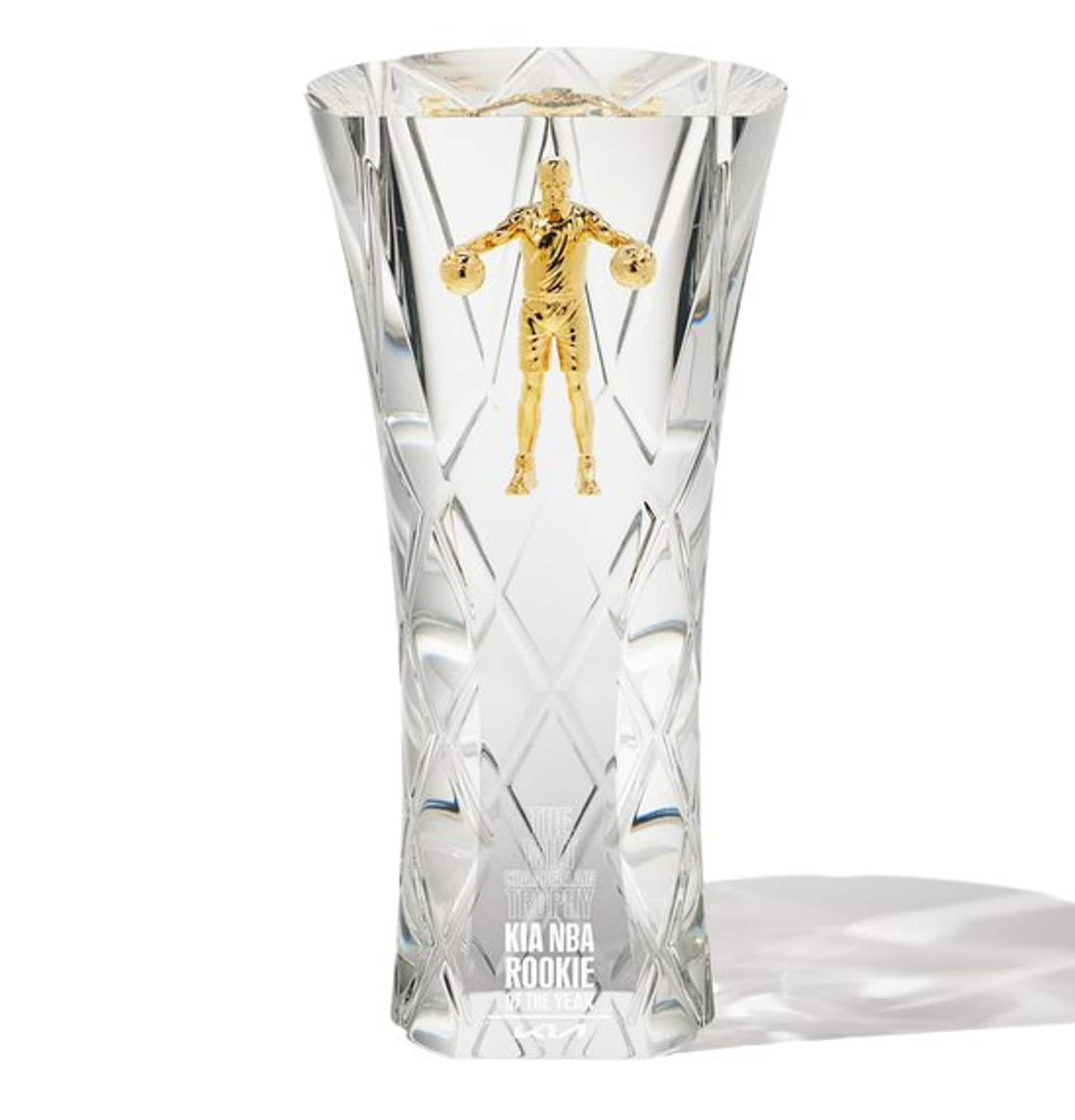
The 2026–27 NBA Rookie of the Year award will be decided by the player who delivers the most impactful performance during the upcoming regular season, with the official winner announced before the settlement window closes in May 2027. Despite AJ Dybantsa being drafted first overall by the Washington Wizards, sportsbooks have opened Cameron Boozer, the third pick from Duke now with the Memphis Grizzlies, as the favourite to win the award, offering odds of +250 at BetMGM[1]. This divergence between draft order and betting lines is notable, as Dybantsa and Darryn Peterson (second pick) were positioned at +400, while Boozer eclipses both despite his lower draft status[1].
Historically, first overall picks have not always secured Rookie of the Year, with recent cases showing that team context and immediate playing time often outweigh draft pedigree. For instance, third or fourth picks have occasionally outperformed top selections when granted larger roles early in their careers, framing the current 0% prediction-market implied probability as an outlier compared to the sportsbook consensus that Boozer holds the edge[1]. Traders should monitor the Grizzlies’ preseason roster announcements and Boozer’s assigned role, as increased minutes will be the primary catalyst for his odds to tighten further[1]. Additionally, the Grizzlies’ injury report and preseason schedule dependencies will directly influence Boozer’s opportunity to shine, making these factors critical to watch as the season approaches[1].
Recent coverage from Yahoo Sports confirms Boozer’s opening status as the favourite, highlighting the market’s shift away from Dybantsa despite his top draft selection[1]. As the 2026 NBA Draft concluded at the Barclays Center, the initial frontrunner dynamics shifted dramatically, with Dybantsa overtaking Peterson in March before Boozer ultimately secured the top betting position[1]. Traders must track the Grizzlies’ official preseason depth charts and any roster moves that could alter Boozer’s playing time, as these announcements will serve as the key indicators for future odds movements[1]. The settlement window ends on 31 May 2027, ensuring the award is resolved before the conclusion of the regular season[1].
Methodology
We track NBA: 2026-27 Rookie of the Year across the five venues with material prediction-market liquidity. The probability shown is the live Polymarket mid; the comparison rows summarise how each venue treats the underlying contract — fees, KYC thresholds, settlement currency, deposit options. The highlighted row marks the cheapest route into Polymarket's order book.
Resolution & payout
Polymarket-based markets settle through the UMA Optimistic Oracle on Polygon. A proposer submits the outcome, a two-hour challenge window opens, and unchallenged proposals finalise the resolution. Payouts settle automatically in USDC the moment the result is final — no bookmaker, no delay.
Kalshi-based markets settle in USD via the CFTC-regulated clearinghouse. Betfair Exchange settles in GBP/EUR net of commission. Manifold is play-money and does not pay out real funds.
FAQ
- What's the difference between YES and NO shares?
- A YES share pays $1.00 if the event happens, $0 otherwise. A NO share pays $1.00 if the event doesn't happen. The market price between 0¢ and 100¢ is the implied probability.
- What does Polymarket cost to trade?
- Polymarket itself charges 0% — the only cost is the Polygon network fee, typically under $0.01 per transaction. Off-chain venues like Kalshi or Betfair charge 2-7% commission.
- How fast are USDC deposits?
- Polygon credits deposits after 12 confirmations — usually under 30 seconds. Withdrawals follow the same path and land back in your wallet within minutes.
- Do I need to KYC for this market?
- On Polymarket directly, no — it's wallet-based. Intermediary brokers like Kalshi vs Polymarket trigger KYC only above $1,500 of lifetime trading volume; under that you trade pseudonymously with a single wallet address.
- How reliable are the quoted odds?
- The YES/NO percentages are the live mid-prices of the Polymarket order book. On deep markets they move every few seconds; on thinner ones you'll see short plateaus.
%22%2F%3E%3Cpath%20d%3D%22M%206%2066%20A%2026%2026%200%200%201%2058%2066%22%20fill%3D%22%23E6B98D%22%20opacity%3D%220.9%22%2F%3E%3Ccircle%20cx%3D%2232%22%20cy%3D%2226%22%20r%3D%2222%22%20fill%3D%22%23F5CBA7%22%2F%3E%3Crect%20x%3D%2210%22%20y%3D%224%22%20width%3D%2244%22%20height%3D%2214%22%20rx%3D%227%22%20fill%3D%22%2322d3ee%22%20opacity%3D%220.9%22%2F%3E%3Crect%20x%3D%228%22%20%20y%3D%2218%22%20width%3D%228%22%20%20height%3D%2218%22%20rx%3D%224%22%20fill%3D%22%2322d3ee%22%20opacity%3D%220.7%22%2F%3E%3Crect%20x%3D%2248%22%20y%3D%2218%22%20width%3D%228%22%20%20height%3D%2218%22%20rx%3D%224%22%20fill%3D%22%2322d3ee%22%20opacity%3D%220.7%22%2F%3E%3C%2Fsvg%3E) and
and%22%2F%3E%3Cpath%20d%3D%22M%206%2066%20A%2026%2026%200%200%201%2058%2066%22%20fill%3D%22%23E6B98D%22%20opacity%3D%220.9%22%2F%3E%3Ccircle%20cx%3D%2232%22%20cy%3D%2226%22%20r%3D%2222%22%20fill%3D%22%23F5CBA7%22%2F%3E%3Crect%20x%3D%2214%22%20y%3D%224%22%20width%3D%2236%22%20height%3D%228%22%20rx%3D%224%22%20fill%3D%22%2322d3ee%22%2F%3E%3C%2Fsvg%3E)
Trade NBA: 2026-27 Rookie of the Year on Kalshi vs Polymarket
Live order book, 0% fees, USDC settlement in seconds.
Open live market →